Köyceğiz Heritage Museuminitiative
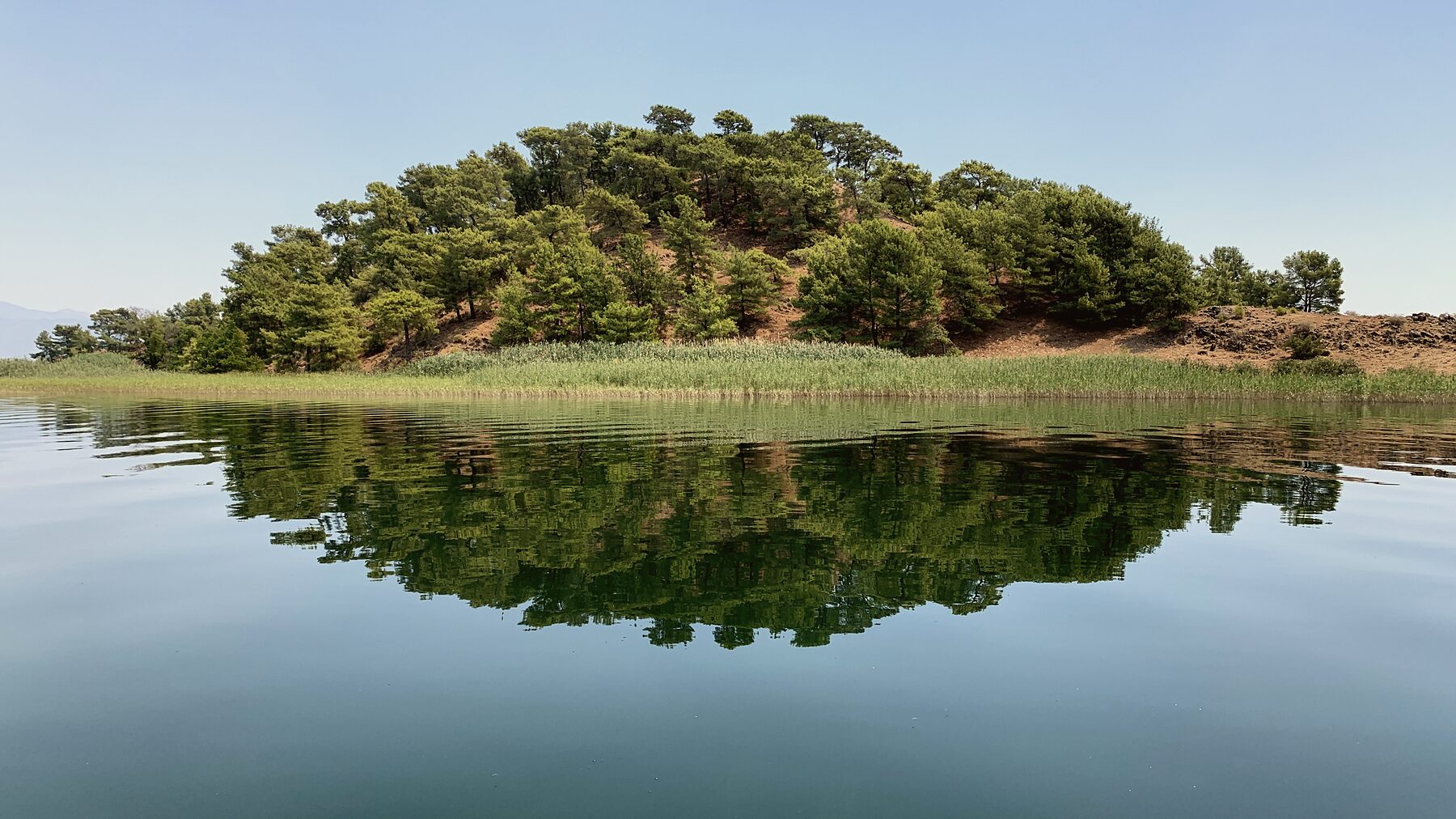
Gedova Island, Lake Köyceğiz
Köyceğiz · Muğla · Türkiye

We have no museum.
We have so many
stories to tell.

This page is a museum. It has six display cases and all of them are empty — because the museum does not exist yet. The labels beneath them say what belongs inside. The emptiness is not a gap; it is the argument.

Photograph: Gedova Island, Lake Köyceğiz · Köyceğiz · Arıktekin, CC BY-SA 4.0 · Wikimedia Commons

scroll
One person, one brick
0/ 12,767
signatures · the target is the town's populationto go 12,767

We count people, not amounts. Every signature is the same size, and every signature stands on the wall under its own name.

The target is the town-centre population given in the project concept file (12,767).

The case

Why a museum is necessary

The general case on top; beneath each, its Köyceğiz counterpart.

01

Preserving cultural heritage

It takes historic artefacts, works of art and natural remains under protection against the ravages of time, and passes them on to the generations to come.

What needs protecting in Köyceğiz is not abstract: the Kaunos excavation has run without a break since 19667 and Fethiye Museum, where the finds are shown, has been closed since 2023 over earthquake safety.10 The objects exist; the roof to keep them in the district does not.

02

Social memory and identity

By showing where a community comes from and what it has passed through, it builds a shared identity and a sense of belonging.

Weir fishing, boats, citrus; tales, verses, games — everything in Cases 05 and 06 is held today only in living memory, and memory thins with every generation.

03

Informal education

It supports learning outside school, making education more lasting and engaging for every age group through visual, aural and interactive objects.

The number of museums in the district today is zero; Köyceğiz has not a single exhibition space that could serve as a place of learning outside school.

04

Scientific research

It offers archaeologists, historians, art historians and scientists first-hand material and a place to work.

The flora of Köyceğiz has no institutional reference collection, although 924 species and infraspecific taxa — 81 of them endemic — are on record for the basin.12 In Muğla's sweetgum forests 108 saproxylic beetle species in 33 families were counted, 15 of them new records for Türkiye13 — while no butterfly survey specific to Köyceğiz could be found in open sources.

05

Getting to know other cultures

By showing the works of other civilisations and ways of life, it grows empathy, tolerance and a universal outlook.

The basin's own layers are enough: Karian, Roman, Byzantine and Ottoman traces surface in the same excavation — in 2023 a structure with a mihrab and coins of Mehmed II were found at Kaunos.5

06

Economic and touristic contribution

It raises a town's cultural standing and, by drawing visitors from home and abroad, contributes seriously to the local and national economy.

We hold no visitor or revenue figures for Köyceğiz, so no number is written here. What is known: Kaunos lies inside the district, and the district's museum count is zero — there is as yet no address to hold a visitor in the town centre.

Six empty cases

Six empty cases

Each label says what belongs inside

How the lake formed, the alluvium, the legend of a settlement beneath the water.empty

Photograph: Lake Köyceğiz, sunset from a jetty · Köyceğiz · small touch, CC BY-SA 4.0 · Wikimedia Commons

01

The Basin

How the lake formed, the alluvium, the legend of a settlement beneath the water.

Alluvium carried by the Dalyan stream filled the Köyceğiz basin over centuries. The lake we see is one moment in a geological process still under way. Small islands sit on the water; Gedova, and the island known locally as Hapishane — Prison — or Aşık — Lovers' — Island, are two of them.11 This is where the narrative spine begins; the other five cases branch from it.

What belongs in this case
A basin section · sediment cores · historic shoreline maps · lake-level records
Kaunos: a harbour closed by silt, and sixty years of excavation.empty

Photograph: Kaunos and the silted plain; Sülüklü Göl at the centre · Dalyan, Köyceğiz · Aerdemsenturk, CC BY-SA 4.0 · Wikimedia Commons

02

Karia's Southern Frontier

Kaunos: a harbour closed by silt, and sixty years of excavation.

The same alluvium severed the port city of Kaunos from the sea, turning its harbour into today's Sülüklü Göl. Excavations have run without a break since 1966, yet none of it has become a single public narrative. One trace of the frontier stands in the middle of the lake: the island holds the ruins of a fort used first for military purposes and later as a prison. Locally the ruins are attributed to the Genoese; no archaeological dating could be found in open sources.11

What belongs in this case
The finds that stay in Köyceğiz · a harbour reconstruction · a timeline of the silt layers · a multilingual narrative
A tree found nowhere else in the world, and the craft of distilling it.empty

Photograph: A sweetgum grove and the stream running through it · Köyceğiz · Barış Ak, courtesy of the photographer

03

The Sweetgum

A tree found nowhere else in the world, and the craft of distilling it.

Oriental sweetgum (Liquidambar orientalis) grows naturally only in this basin. The forest around the lake fell from 6,500 to 800 hectares in fifty years. The balsam's story, though, is not over: unlicensed tapping is illegal, and production continues under the state — the Köyceğiz Forest Directorate's plant at Kavakarası runs an April-to-October season, with 1 tonne of oil and 3 tonnes of incense planned for 2026 from a 50-hectare stand.14 The craft has not vanished but has narrowed to a single facility and a small area; the breadth of the knowledge — stripping bark, distilling, storing the balsam — still waits to be recorded. Nor does the tree stand alone: the sweetgum forest carries an insect community of its own.13

What belongs in this case
A still · bark knives · styrax vessels · recordings made with the producers · a map of the forest's retreat, year by year
A scientific reference collection of the local flora — it does not exist.empty

Photograph: A Liquidambar sheet at the Neuchâtel Herbarium — but the American species (L. styraciflua). No such record exists for Köyceğiz's own sweetgum. · Switzerland — not Köyceğiz · Neuchâtel Herbarium, CC BY-SA 3.0 · Wikimedia Commons

04

The Herbarium

A scientific reference collection of the local flora — it does not exist.

This is the case that turns a museum from an exhibition space into an institution: a continuously updated record kept with a university, where the number of specimens added and papers served can be measured. Today the flora of Köyceğiz has no institutional reference at all. Yet there is no shortage of things to record: from some 1,700 specimens collected in the Köyceğiz-Dalyan Special Environmental Protection Area, 924 species and infraspecific taxa in 470 genera and 110 families were identified — 81 of them endemic, 20 rare.12 The fauna tells the same story: a study of sweetgum forests in Muğla counted 108 saproxylic beetle species in 33 families, 15 of them new records for the fauna of Türkiye13 — yet no reference insect collection exists in the region, and no butterfly survey specific to Köyceğiz could be found in open sources.

What belongs in this case
A plant press · acid-free sheets · an accession register · a numbering system shared with a university · a beetle collection from the sweetgum forest — and the first thousand specimens
A lake with a foot, white water lilies, weir fishing and citrus.empty

Photograph: The lakeshore on an ordinary morning · Köyceğiz · Barış Ak, courtesy of the photographer

05

Lake and People

A lake with a foot, white water lilies, weir fishing and citrus.

Köyceğiz empties its fresh water into the sea through the Dalyan Channel — and takes salt water back in return. Locally this is called an ayaklı göl, a lake with a foot; the account told here is that seven exist in the world and this is the only one in Türkiye. The same regime feeds the lake's white water lilies, which nobody monitors on any regular basis. The town, founded in 1860, grew on this water too — weir fishing, citrus, boats. The contents of this case are still held in living memory.

What belongs in this case
A salinity and depth section of the lake · white water lily monitoring records · a model of the weirs · boat and net tools · citrus crates · family albums
Tales, folk verses, games, recipes — none of them fit on a shelf.empty

Photograph: The market at Köyceğiz · Köyceğiz · Maria Jonker, CC BY-SA 3.0 · Wikimedia Commons

06

Intangible Heritage

Tales, folk verses, games, recipes — none of them fit on a shelf.

What a museum loses most easily is what cannot be put in a case: tales and stories, children's games, folk dances, mani verses, recipes; the visit to a newborn, the send-off for a conscript, the house of mourning — everything whose method is known only while it is being done. UNESCO calls this intangible cultural heritage. Even the lake's island carries an example: locals also tell of Hapishane Island as Aşık — Lovers' — Island, where two young people whose families refused them took refuge and died of a snakebite. The source itself ties this to the widespread Anatolian "island and snake" tale type; it is not history, but exactly the kind of account this case exists to hold.11 In Köyceğiz all of it is held in memory, and memory thins with every generation. This case is filled by a recording, not an object.

What belongs in this case
Audio and video recordings · a collection of tales, verses and songs · films of children's games and folk dances · recipe notebooks · a calendar of customs (the newborn visit, the conscript's send-off, mourning) · a transcript and subtitle archive
Close-up · Case 02

The lion in the middle of town

The emblem of Köyceğiz came out of an illegal dig. The only text that explains it is a plaque bolted in beside it.

The Lion of Kaunos on the square at Köyceğiz — 23 October 20111965

Photograph: The Lion of Kaunos on the square at Köyceğiz — 23 October 2011 · Köyceğiz · Kjf webmaster, CC BY-SA 3.0 · Wikimedia Commons

Everyone crossing the square walks past it: a white marble lion, seated on a low plinth under a plane tree. It is the district's emblem; the film festival held twelve times was named after it. For anyone who wonders where it came from, the only source is the plaque at its side.19

Object record
Object
Seated lion, white marble
Provenance
Kaunos — Dalyan, Köyceğiz1
How it surfaced
Illegal excavation, 19651
Context
A monopteros: a round structure with female statues between its columns and four lions at its corners1
Date
The reign of Augustus — 27 BC – AD 141
This lion
One of the four1
When the context was dug
1972–73 — seven years after the object1
Today
On the square at Köyceğiz, in the open air1
The other three lions
Whereabouts unknown — we could find no public record

This is how a museum label begins. Most of these lines rest on a single plaque; two of them no source could fill.

The information plaque beside the statue

Photograph: The information plaque beside the statue · Köyceğiz · Kjf webmaster, CC BY-SA 3.0 · Wikimedia Commons

The only label this object has ever had
It was found during an illegal excavation at Caunos in 1965. Archaeological excavations carried out at its site in 1972–73 revealed the remains of a round structure, the Monopteros. This structure, built as a sacred monument, is dated to the reign of Augustus (27 BC – 14 AD). It was determined that between the columns of this round structure were female statues and four corners lion statues. This statue is one of the four lions, which likely had apotropaic function.

This is how the plaque looked in 2011. Only the last sentence of the Turkish text falls inside the frame; the passage below is the plaque's English text.1

Three accounts, one object

Three texts about this lion are in circulation today. They do not say the same thing and none of them answers the others. This page cannot decide which is right — but this is exactly what a museum is for: to put a claim next to its source, and to show a contradiction rather than hide it.

The plaque on the square1

“…one of the four lions, which likely had apotropaic function.” The plaque calls the structure a sacred monument and gives the lions an apotropaic role — warding off evil.

It never mentions an ox head.

The district governorate's page2

“The crushed ox head under the right paw of the Lion of Kaunos represents the enemy civilisations of the Kaunian period.” Here the same object is not a guardian but a trophy of victory.

No source is given for the claim.

The academic reading4

A square substructure and a circular superstructure: a monopteros about 5.50 m high and 2.90 m in diameter. Three female statues and a herm were recovered. Together with the corner lions this leads to reading the building as a funerary monument.

The plaque says “sacred monument”; this reading says “funerary monument”.

Sixty years of one object

  1. 1840

    R. Hoskyn identifies the ruins as Kaunos from an inscription. The city enters the scholarly record.3

  2. 1965

    The lion is taken out in an illegal excavation. The object survives; its context does not. Where it lay, in which layer, next to what — none of it is recorded.1

  3. 1966

    Baki Öğün opens the first scientific excavation at Kaunos. In his own words: “It was love at first sight. Seeing the ruins, I was as happy as a child.”3

  4. 1972–73

    The team excavates the findspot; the monopteros comes to light. Everything known about this object today rests on that hole, reopened seven years later.1

  5. 2001

    Öğün dies in office after 35 seasons. His student Cengiz Işık takes over as director.3

  6. 2006–2018

    The Köyceğiz Kaunos Golden Lion Turkish Film Festival runs twelve times, named after the lion on the square. After 2018 it is never held again.9

  7. 2014

    Kaunos is submitted to the UNESCO World Heritage Tentative List.8

  8. 2021

    Işık's student Ufuk Çörtük becomes excavation director. The third generation at Kaunos.3

  9. 2023

    Fethiye Museum, where the Kaunos finds are displayed, closes to visitors over earthquake safety. There is still no reopening date.10

  10. 2026

    The excavation has run without a break for 60 years. Number of museums in the district Kaunos lies in: zero.7

Dalyan · Kaunos

The dig is still going

Kaunos sits directly across from Dalyan, a neighbourhood of Köyceğiz. The excavation has not missed a season since 1966 — sixty years as of 2026. The team is led today by Assoc. Prof. Ufuk Çörtük, who also wrote the excavation's own research history.37

Recent seasons have concentrated on the 3,250 m² monastery complex inside the archaic walls: cisterns, vaulted rooms, multi-room building groups, narrow streets. In 2023 a structure with a mihrab and two coins from the reign of Mehmed II were found — the first hard evidence against the assumption that Turks settled at Dalyan rather than at Kaunos itself. In 2025 the water channel of the agora fountain was repaired and the fountain began to run again after 2,300 years; the same season a health building of the 2nd–3rd century yielded scalpels, probes, cannulas and catheters.56

None of this is told in Köyceğiz.10

Bases of honorific monuments in the harbour agora — the statues that stood on them are gone

Bases of honorific monuments at Kaunos whose statues are lost. The inverse of the lion on the square: here the context stands and the object is gone.

Photograph: Bases of honorific monuments in the harbour agora — the statues that stood on them are gone · Kaunos — Dalyan, Köyceğiz · Dosseman, CC BY-SA 4.0 · Wikimedia Commons

The case

Why this museum should be the one to tell it

01

Context disappears before the object does

The lion survived; its record did not. Everything we know about it we owe to the team going back seven years later and digging the hole the looters left. A museum is the institution that keeps an object and its context under one roof — so the next find does not have to be rescued backwards.

02

With nobody keeping the record, the account decays on its own

The plaque says “guardian”, the district's official page says “enemy civilisations”, and neither cites a source. The same page still describes a festival that ended in 2018 as one “held every year”. Not because anyone is lying — because no institution is responsible for correcting it.

03

Sixty years of excavation with no local public face

Every season produces reports, finds and new questions: a structure with a mihrab and coins of Mehmed II; the agora fountain running again after 2,300 years; a Roman health building with scalpels and catheters. The reports go to journals, the finds to Fethiye. Between the trench and the town there is nothing.

04

The room that tells the finds is shut

Kaunos lies inside the district, yet both the site and its finds are administered by the Fethiye Museum Directorate. That museum has been closed to visitors since 2023 over earthquake safety, with no reopening date. So the case that tells Kaunos exists neither in Köyceğiz nor, at present, open in Fethiye.

05

This is not about taking the lion off the square

The proposal is not to move the statue. The proposal is a room that shows where it came from, which three lions stood beside it, what those four were for, and who claims so on the strength of which source. The lion can stay on the square; its story gets an address.

Sources

Every claim in this section is tied to a numbered source. Where sources contradict each other, the contradiction is written down too; lines that could not be filled are left empty.

  1. The information plaque on the square, Kaunos Aslanı / Lion from Caunos, Köyceğiz. Photograph: Kjf webmaster, 23 Oct 2011, CC BY-SA 3.0, Wikimedia Commons. source →
  2. Köyceğiz District Governorate, “Kaunos Antik Kenti” (accessed 23 Aug 2026). source →
  3. Ufuk Çörtük, “Kaunos Antik Kenti Araştırma Tarihçesi”, bitig Edebiyat Fakültesi Dergisi 2/4 (2022), 298–321. Baki Öğün's words are quoted in this article (Öğün 1998: 175 ff.). source →
  4. Anadolu'da Dairesel Planlı Tapınaklar (Circular-plan temples in Anatolia), unpublished MA thesis, Akdeniz University — the measurements of the Kaunos monopteros and its reading as a funerary monument. source →
  5. Anadolu Agency, “Traces of the Ottoman period found in the excavations at Kaunos”, 18 Aug 2023. source →
  6. CNN Türk, “An 1,800-year-old hospital and a 2,300-year-old fountain found at Kaunos”, 15 Sep 2025. source →
  7. Türkiye Turizm, “Excavations at Kaunos have run without a break for 60 years”, 6 May 2026. source →
  8. UNESCO World Heritage Centre, Ancient City of Kaunos — Tentative List, submitted 15 Apr 2014. source →
  9. Aydınlık, “The Köyceğiz film festival has not been held for 7 years”, 17 Dec 2025. source →
  10. Ministry of Culture and Tourism, MüzeKart — Fethiye Museum: “Closed to visitors” (accessed 23 Aug 2026). The Kaunos site is administered by the same museum directorate. source → reason for the closure →
  11. Köyceğiz District Governorate, “Köyceğiz Gölü” (accessed 26 Aug 2026) — the island's military and prison use, fort ruins attributed to the Genoese, and the Aşık Island legend, which the page itself ties to the widespread Anatolian “island and snake” tale type. source →
  12. Ministry of Environment and Urbanisation, Special Environmental Protection Areas — Köyceğiz-Dalyan booklet (PDF; accessed 26 Aug 2026): c. 1,700 specimens; 924 species and infraspecific taxa in 470 genera and 110 families; 81 endemic and 20 rare species classified under IUCN criteria. source →
  13. İ. Harman & M. Avcı, “Contributions to the knowledge of Turkish saproxylic beetle fauna of Anatolian sweetgum forests”, Turkish Journal of Entomology 47/4 (2023), 415–431. 1,302 individuals from two sweetgum plots in Muğla; 108 species in 33 families; 15 new records for the fauna of Türkiye. The study does not give a district-level location, hence “sweetgum forests in Muğla” in the text. source →
  14. General Directorate of Forestry, Muğla Regional Directorate, “Sweetgum oil production has begun in Köyceğiz”, 23 Jun 2026 — the Kavakarası facility, April-October season, 50 hectares, 1 tonne of oil and 3 tonnes of incense planned for 2026, closed heating system. source →
0

of the sweetgum forest lost in fifty years — from 6,500 to 800 ha

0

years of continuous excavation at Kaunos — none of it told in Köyceğiz

0

lakes in the world said to have a “foot” — Köyceğiz is Türkiye's only one

0

museums in the district — today

0

endemic plant species recorded in the Köyceğiz-Dalyan protection area — with no reference collection in the district

The sweetgum, excavation and museum figures come from the project concept file. The count of lakes with a “foot” is an account told locally; none of it has been independently verified. The endemic species count comes from the Ministry of Environment and Urbanisation's Köyceğiz-Dalyan Special Environmental Protection Area publication (source 12).

Digital signature

Put your name on the wall

These signatures are not a petition but a public record. Your name and one-sentence reason go into the list of requests attached to the initiative's formal application.

Are you from Köyceğiz?

We do not ask for an email address or a phone number. To have your entry taken down, just write to hi@wakaresearch.com.

Your brick is laid.

The signature wall

0 / 12,767

The wall is still empty.

Like the museum. Lay the first brick.

Beyond a signature

More than a signature

What fills these cases is not a budget line but the material in your hands. These six routes are the real ways to close the gap.

01

Tell a story

A tale, a mani verse, a children's game, a recipe; what you remember of weir fishing, distilling, boats or old Köyceğiz — all of it becomes the first piece of the oral history archive. The recording is filed under your name and a copy goes to your family.

02

Give a photo or document

A frame from a family album, a deed, a letter. We scan at high resolution; the original stays with you.

03

Offer expertise

Botany, archaeology, archiving, law, architecture, museum practice. The scientific advisory board will be formed from this pool.

04

Buy a brick

Fundraising opens only once a formal legal body exists. When it does, the unit stays the same: one person, one brick.

Not open yet
05

Volunteer

Field trips, album scanning days, transcribing interviews, translation. A single day of work counts.

06

Share

The counter moves for one reason only: someone shows this page to someone who knows Köyceğiz.

Photograph: A botanist collecting a specimen in the field · Idaho, USA — not Köyceğiz · BLMIdaho, Public domain · Wikimedia Commons
Photograph: Dalyan, 1998 · Dalyan, Köyceğiz — 1998 · Dosseman, CC BY-SA 4.0 · Wikimedia Commons

Open call

The Köyceğiz Photo Archive

A museum building takes years; an archive can start today.

We are building the photographic archive of Köyceğiz together — not nature alone, but nature and people: faces that are gone, shops that have closed, a shoreline that has changed. Whether your frame was taken yesterday or fifty years ago, it enters the archive with its credit line and becomes part of the first collections when the museum is founded. This call is made in the name of the Köyceğiz Heritage Museum initiative.

What you can send
  • The lake and the shore
  • The market street and its shops
  • The sweetgum forest and forest work
  • The weirs and fishing
  • Weddings, festivals, communal work
  • School and neighbourhood
  • Buildings that are gone
What we ask with every frame

Who took it, when, where, and who is in it. No frame is published without a credit line — the same rule that governs every photograph on this page. AI-generated images are not accepted.

Consent and privacy

By sending a photograph you declare that you consent to its publication. If recognisable people appear in the frame, their consent (or their family's) is sought before anything is published; if you are not sure, do not send it. A sender can ask at any moment for a frame to be removed from the archive and from publication — one email is enough. Frames are used under a "courtesy of the photographer" credit by default; you may choose a CC BY-SA licence instead.

How to send

Two channels for now: email to hi@wakaresearch.com, or a message to our Instagram account. Send the frame at the highest resolution you have; the original stays with you.

An ecosystem whose loss is documented, and a body of knowledge held only in living memory — the work of this museum is to make them visible before they are gone.

Sign — lay a brick
One person, one brick

Signatures build this wall

Köyceğiz has no museum yet. We keep a single number to make the demand visible: how many people have signed. Not donations — participation. Everyone's contribution is the same size.

0 signatures · 12,767 bricks to go

This window appears only once.